

The Deepfake That Changed the Conversation: AI Video’s Most Turbulent Week
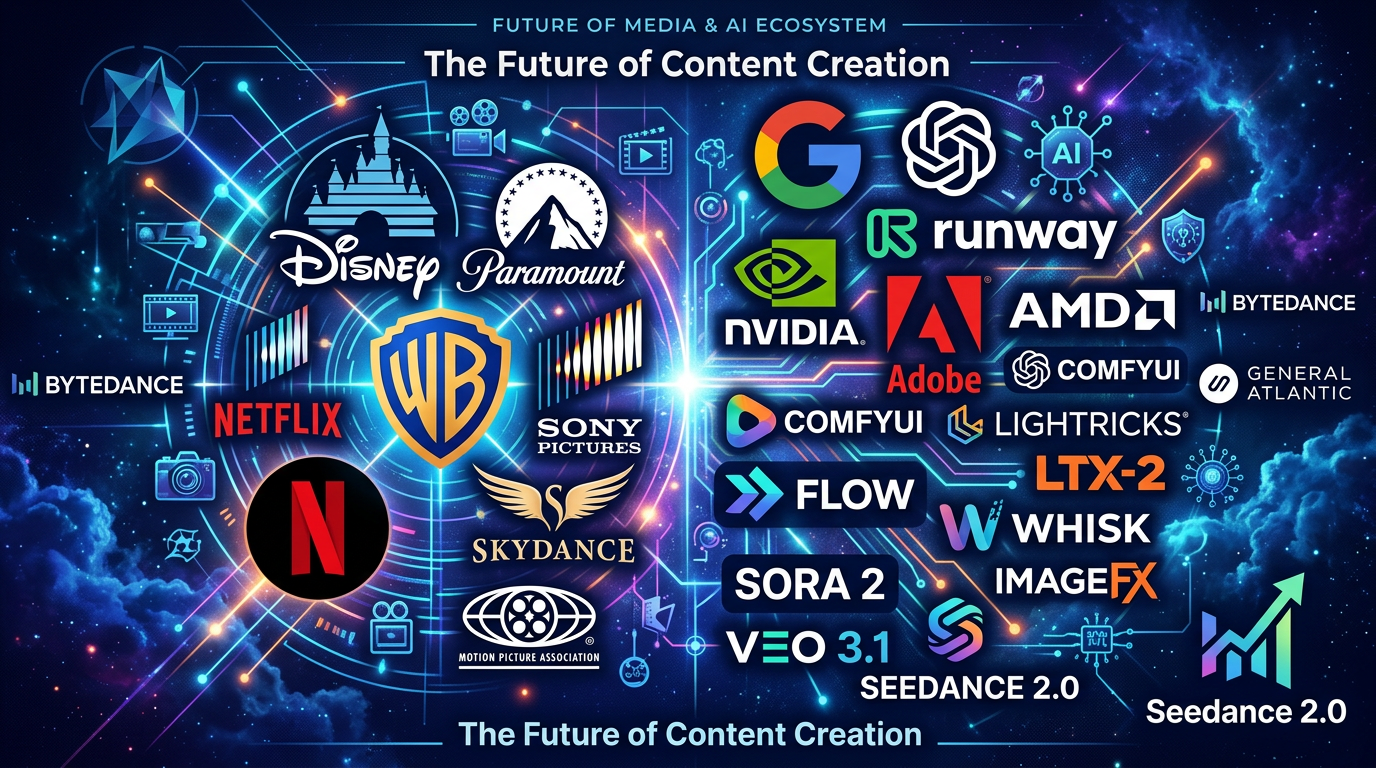
The week of February 16–22, 2026 brought AI video out of the industry press and into the global conversation. A 15-second AI-generated clip depicting Tom Cruise and Brad Pitt went viral, triggering disbelief, outrage, and fascination in equal measure. Roger Avary announced the first major AI-first production company backed by real theatrical release dates, ByteDance pledged safeguards under mounting legal pressure, and SAG-AFTRA proposed a landmark “Tilly tax” on synthetic performers—the most significant union policy proposal in the AI era so far.
The Cruise-Pitt Clip: When AI Video Hit the Mainstream
On February 16, 2026, Irish filmmaker Ruairi Robinson posted a 15-second AI-generated video to social media that would become one of the defining moments of the AI video era. The clip showed Tom Cruise and Brad Pitt engaged in a fight on a burned-out highway overpass, rendered with cinematic lighting, proper shadow behavior, and facial fidelity that was, for most casual viewers, indistinguishable from genuine footage. It was created using ByteDance’s Seedance 2.0, which had launched just days before.
The video spread across platforms within hours. The reaction split roughly into three camps: those who were impressed by the technical achievement, those who were alarmed by the implications for consent and intellectual property, and those who simply could not believe it was AI-generated until they read the caption a second time. That last group was the most significant. The test of AI video’s cultural impact was never whether it could impress the technically sophisticated—it was whether it could fool the inattentive, and the Cruise-Pitt clip demonstrated that threshold had been crossed. The actors had no involvement in the video. Neither had consented. Their likenesses had been synthesized from training data drawn from decades of films, interviews, and public appearances. Within the same week, Hollywood’s legal teams were already working to ensure ByteDance would not use them as a demonstration platform again.
Roger Avary Bets His Next Films on AI
On February 16, 2026, Roger Avary—Oscar-winning co-writer of Pulp Fiction—appeared on The Joe Rogan Experience and made an announcement that reframed the industry’s internal conversation about AI adoption. Avary revealed that he had founded General Cinema Dynamics, a production company structurally built around AI-first filmmaking, in partnership with Massive AI Studios. The company had secured funding for three films: a family Christmas movie targeting theatrical release during the 2026 holiday season, a faith-based feature scheduled for Easter 2027, and a sweeping romantic war epic.
What made Avary’s announcement significant was not just its existence but its specificity. These were not vague “AI-assisted” projects; they were films with theatrical release targets, funding in place, and a creative methodology that treated AI as central rather than supplementary. Avary was not experimenting with AI for short-form content or internal previsualization. He was staking his next three to four years of creative output on AI as a production infrastructure. The announcement landed the same day the Cruise-Pitt clip went viral, and the juxtaposition was revealing: one story showed AI video being used without consent to generate unauthorized content, while the other showed an established filmmaker actively choosing AI as his primary creative collaborator.
ByteDance Pledges Safeguards—Pauses Global Rollout
Under mounting pressure from multiple cease-and-desist letters and public condemnation from the Motion Picture Association, ByteDance made a significant concession during the week of February 16–22: the company announced it would add substantial new content moderation safeguards to Seedance 2.0 and paused its planned global rollout of the model while the work was underway. The specific safeguards promised included stronger filters against the generation of content featuring recognizable public figures and enhanced detection of copyrighted intellectual property within input and output data.
ByteDance’s response was notable both for what it included and what it did not. The company committed to preventing users from explicitly generating videos based on Hollywood IP—a meaningful gesture toward rights holders. But the deeper issue, whether Seedance 2.0 had been trained on copyrighted content without permission, remained unaddressed. Training data questions would require legal resolution rather than content filter implementation, and ByteDance avoided making any commitments about its training pipeline. The pause in global rollout suggested the company recognized it could not scale into new markets while simultaneously managing an active legal confrontation with the entire American entertainment industry.
SAG-AFTRA Proposes the “Tilly Tax”
In the most consequential labor policy development of the week, SAG-AFTRA formally proposed what it termed a “Tilly tax” as part of its ongoing negotiations with the Alliance of Motion Picture and Television Producers. Named in reference to the challenge of replacing human creative performers with synthetic alternatives, the proposed tax would require studios to pay royalty fees whenever AI-generated performers appeared in productions, with proceeds distributed to original performers whose likenesses and creative work had contributed to the model’s capabilities.
The proposal represented a strategic evolution in how performers’ unions were approaching AI regulation. Rather than seeking prohibitions—a strategy that had already been weakened by the pace of technology adoption and the industry’s covert AI use—SAG-AFTRA was building a framework that accepted AI-generated performance as an eventual reality while demanding that original performers receive ongoing economic participation in the value created from their contributions. The “Tilly tax” model was analogous to mechanical royalties in music: a statutory licensing framework where the use of AI-synthesized creative work would generate automatic compensation rather than requiring individual negotiation for each production.
Sora 2’s “Static Character” Tool Changes Narrative Filmmaking
OpenAI made a quiet but significant product update during the week of February 16–22 with the broader rollout of Sora 2’s “static character” tool, which allowed users to upload a photograph of any character—real or created—and generate multiple scenes with that character in different environments, costumes, and situations while maintaining consistent facial details and clothing style across all outputs. For narrative filmmakers, this solved one of the most persistent frustrations with AI video: the difficulty of building a coherent visual identity for a character across scenes.
Previously, generating the same character across multiple clips often required substantial prompt engineering and acceptance of visual drift—subtle inconsistencies in hair, facial structure, or clothing that accumulated across scenes and broke the illusion of continuity. The static character tool addressed this architecturally by anchoring the character representation in the generation process rather than re-deriving it from text descriptions alone. Combined with Sora 2’s instruction-based object manipulation—which allowed creators to modify specific elements within generated footage without re-rendering entire compositions—the week’s update positioned Sora 2 as increasingly viable for narrative storytelling rather than just impressionistic short clips.
The Covert Adoption Paradox
By February 22, the gap between what studios said publicly about AI and what they were doing privately had become sufficiently documented to constitute a pattern rather than an isolated observation. Multiple industry reports surfaced during the week confirming that AI tools were being used in script development, visual effects generation, production design, color grading, and synthesis workflows at studios that had not publicly disclosed their AI use and whose public statements continued to emphasize the primacy of human creative work.
This covert adoption was not simply deceptive—it reflected genuine institutional tension. Legal teams were advising that public acknowledgment of AI use in productions covered by union contracts could trigger grievances. Marketing teams were concerned that audience backlash against AI-generated content could undercut promotional campaigns. And creative executives were under pressure to hit production timelines with budgets that had not grown proportionally to what productions now needed to deliver. The result was a kind of strategic ambiguity that allowed studios to capture the efficiency gains of AI adoption while deferring the reputational and legal costs of acknowledging it.
What February 16–22 Tells Us About Where AI Video Is Heading
The week of February 16–22, 2026 was the moment AI video stopped being an industry story and became a cultural one. The Cruise-Pitt clip did not demonstrate a new capability—it demonstrated an existing capability to an audience that had not yet internalized it. Most people outside the AI video community had not understood that this level of realism was already accessible to creators with a smartphone and an account on a platform. The clip made it undeniable, and the response—studio legal action, union proposals, filmmaker announcements, corporate pledges—demonstrated that the industry was now operating in a reality where AI video’s consequences were visible, not just speculative.
The “Tilly tax” proposal is perhaps the most revealing indicator of where things are heading: toward negotiated frameworks rather than prohibitions. SAG-AFTRA was not asking for AI-generated performers to be banned; it was asking for royalty structures. That is the posture of an institution that has concluded the technology will be adopted regardless and has chosen to negotiate for participation in its economics rather than fight its existence. Whether that negotiation succeeds will shape the industry’s relationship with AI for the next decade.

